Disclaimer: This article is for informational purposes only and does not constitute financial or investment advice. Cryptocurrency markets are highly volatile. Always do your own research before making any investment decisions.
XRP isn’t following Bitcoin’s path. It sits in a different part of the market, where demand comes from usage rather than scarcity.
XRP entered 2026 with its strongest fundamentals ever. So why is the price still falling?
We break down 10 common questions people actually ask about Ripple and XRP – from how the token works to whether it can realistically deliver Bitcoin-level returns.
Why XRP Is Falling Despite Strong Fundamentals?
Goldman Sachs holds $153 million in XRP. Mastercard just plugged Ripple into $9 trillion in annual payment flows. The SEC dropped its case, handed XRP commodity status, and walked away. And the price is still sitting at $1.30 – down 64% from its peak.
If you're trying to figure out what's actually going on with XRP in 2026, you're not alone. The gap between Ripple’s growth and XRP’s price is what’s confusing most investors right now.
Below are the 10 that come up most – answered with current data, no hype, and a clear position where one is warranted.
Is XRP the Same as Bitcoin?
No, and this is where most comparisons fall apart before they even get started.
One Reddit user framed it plainly: "It can do everything BTC can do, but faster and cheaper. To me it should already be #1."
That’s technically accurate on the speed and cost side. But Bitcoin's value was never about efficiency.
Bitcoin is a store of value. Scarcity drives it. Fixed supply, no issuer, no company behind it. XRP is built for a different job. It’s a utility token tied to Ripple’s payment system. Its value comes from usage.
Buying XRP because you want Bitcoin returns is a category mistake. One stores value. The other moves it.
What Is XRP Actually Used For?
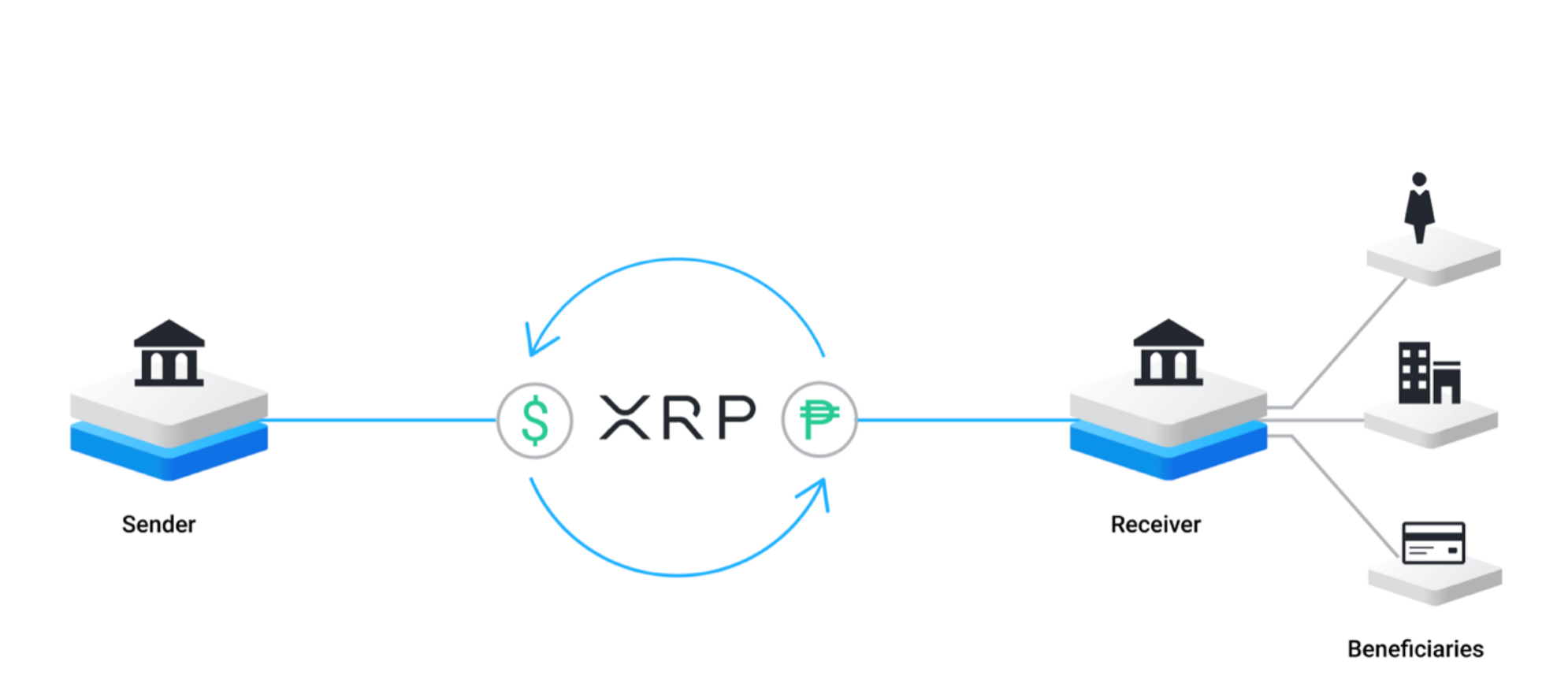
XRP acts as a bridge asset in cross-border payments through Ripple’s On-Demand Liquidity.
A bank sending money across borders converts fiat into XRP, moves it in seconds, then converts it back. No pre-funded accounts. No idle capital.
Here’s how that transfer actually moves.
XRP moving between banks as a bridge asset in cross-border payments.
The performance gap is real:
Bitcoin handles ~7 transactions per second
XRP Ledger handles ~1,500
But speed alone is not the moat.
The answer is infrastructure. XRP’s edge comes from liquidity corridors, regulatory coverage, and integrations built over more than a decade.
One constraint remains: XRP is only used when ODL is used. Many partners still operate without it.
Why did Goldman Sachs buy $153M in XRP?
Because institutional positioning shifted before price did.
Goldman Sachs holds roughly $153M in XRP exposure, with Millennium adding another ~$23M.
ETF data confirms the trend:
~$1.2B cumulative inflows since launch
~$159M YTD inflows
still trading near cycle lows
That combination matters because money is entering while price is falling, which usually signals accumulation rather than exit.
At that point, the question shifts from analysis to execution. The ability to act immediately, without routing through exchanges, changes how quickly you can respond, and ChangeNOW can help you react pretty quickly.
The catch: most ETF capital is still retail-heavy, with institutions making up a minority share.
A question that keeps coming up is simple: do banks actually use XRP, or just Ripple?
Over 300 financial institutions are connected to RippleNet. On the surface, that looks like broad adoption. In reality, the picture is different.
Connection is not usage. Banks use Ripple’s infrastructure in two ways.
Most rely on it for messaging, replacing legacy coordination systems while still settling in fiat.
A smaller group uses On-Demand Liquidity, where XRP acts as the bridge between currencies.
Only this second group creates real demand for the token.
Here’s how that split looks in practice:
Region
Institution
Uses XRP (ODL)
Role in Network
What it means for XRP
Asia-Pacific
SBI Remit (Japan)
Yes
Remittance corridors
Direct demand driver
Asia-Pacific
UnionBank (Philippines)
Yes
Retail transfers
Active usage
Asia-Pacific
Siam Commercial Bank (Thailand)
No
Payment infrastructure
No token demand
North America
PNC Bank (USA)
No
Payment routing
No impact
North America
American Express (USA)
No
B2B settlement
No token exposure
Europe
Santander
No
One Pay FX
Limited relevance
Europe
Standard Chartered
No
Cross-border rails
Indirect exposure
Middle East
Zand Bank (UAE)
Yes
Regional corridors
Growing demand
Middle East
RAKBANK (UAE)
No
Corridor testing
Potential only
Latin America
Travelex Bank (Brazil)
Yes
FX flows
Strong usage signal
Africa
Standard Bank
No
Network integration
No direct demand
That gap explains the disconnect: Ripple can expand globally, sign new partners, and grow its infrastructure. XRP only moves when those flows actually run through ODL, not when they are announced.
Could XRP Replace SWIFT?
SWIFT still processes the majority of global cross-border payments, and that position is not going anywhere in the short term.
What’s happening instead is overlap. Banks are not choosing between SWIFT and Ripple, they use both depending on the corridor, cost, and regulatory setup.
That shift is already visible. Traditional players are not standing still either. SWIFT itself is actively developing blockchain-based infrastructure and working with major banks to modernize cross-border payments, rather than being replaced outright.
XRP is not competing for the entire system. It competes for specific flows where capital efficiency matters. There is no single disruption event here, just a gradual shift as certain corridors start moving away from traditional rails.
This classification places XRP alongside Bitcoin and Ethereum under the same category and removes the legal uncertainty that previously limited exchange listings and institutional access.
At the same time, regulatory clarity does not create demand. It does remove friction, but it does not generate usage.
Why Does XRP Drop Every Time Ripple Announces Good News?
Because most of that news never reaches XRP. Ripple can sign deals, expand its network, build infrastructure: the token isn’t required, so demand doesn’t follow.
Even regulatory clarity didn’t shift that. The narrative improved, price didn’t.
At the same time, there’s supply sitting above. A lot of holders bought higher, and every move back toward those levels turns into selling. Not panic – just people getting out.
That’s where momentum dies. Not on bad news, but on positioning and until that supply gets cleared, upside stays capped.
Does Ripple's own stablecoin RLUSD compete with XRP?
Partially. RLUSD takes over some settlement flows that would otherwise use XRP, but not all.
RLUSD introduces something XRP never had – price stability. That changes how settlement works inside Ripple’s infrastructure.
XRP was built as a bridge between currencies. During the transfer, value is briefly exposed to price swings. For large volumes, even that window matters.
RLUSD removes that exposure. The amount sent is the amount received.
The difference shows up in how each asset is used:
Aspect
XRP
RLUSD
Role in payments
Bridge between currencies
Direct settlement asset
Price behavior
Moves during transfer
Stays flat
Risk profile
Exposure during execution
Minimal
When it is used
Inside ODL flows
Across different flows
Adoption barrier
Needs liquidity corridors
Fits into existing rails faster
The overlap sits at the settlement layer.
Some flows no longer need XRP. Stable settlement is easier to justify, especially where predictability matters more than speed.
XRP still has a role. It remains useful in less liquid corridors or where pre-funded capital is inefficient.
What happens next depends on usage. If ODL expands inside those flows, XRP keeps relevance. If settlement shifts toward stable assets, its role becomes narrower.
XRP as Next Bitcoin: Real or Hopium?
XRP is currently trading around $1.30–$1.35, down 64% from its all-time high of $3.65 in July 2025. Bitcoin is around $66,000–$69,000, down roughly 45–48% from its October 2025 peak.
For XRP to match Bitcoin's current market cap, it would need to trade at roughly $15–$17 per token – a 12x from today. For XRP to reach $100,000 per token the way Bitcoin has: at 100 billion tokens in circulation, that implies a market cap larger than global GDP. It doesn't work mathematically.
XRP doesn't need to become Bitcoin to deliver serious returns though.
A more relevant comparison: $1,000 invested in XRP at $0.50 in November 2024 was worth $7,300 at the July 2025 peak – a 630% gain in under a year.
From $1.30 today, the same percentage move puts XRP at roughly $10.
Standard Chartered's Geoffrey Kendrick has an $8 target for end of 2026, contingent on ETF inflows reaching $10 billion. From $1.30, that's a 6x.
Scenario
XRP target
What has to happen
Bear
$0.97–$1.15
$1.28 support breaks, macro deteriorates further
Base
$2.00–$3.00
ETF inflows recover, CLARITY Act passes in April
Bull
$5.00–$8.00
ODL corridors scale, institutional settlement picks up
Ultra bull
$10+
Major banks shift from messaging-only to live XRP settlement
About 48% of XRP's circulating supply is currently underwater – the same level it hit right before the November 2024 breakout.
XRP has a pattern of consolidating for months, looking dead, then moving hard when the next catalyst lands. The CLARITY Act vote in late April is that catalyst.
Pro Tip: Don't track partnership announcements. Track active ODL corridors and weekly ETF flows. In March 2026, $31 million walked out of XRP ETFs in a single month – that's the kind of institutional signal that matters more than any press release.
XRP vs Bitcoin in 2026: What’s the Difference?
XRP and Bitcoin serve different roles. Bitcoin is held as a long-term asset. XRP is used in payment flows.
This is how the question shows up in real discussions:
Bitcoin has a clear demand driver and more stable positioning. XRP depends on real transaction volume – without active flows, demand stays weak.
They don’t compete directly. They reflect different parts of the market.
Pro Tip: XRP is not underperforming because fundamentals are weak. It is underperforming because those fundamentals do not consistently translate into token demand.
Cardano vs Ethereum comparison covering fees, DeFi liquidity, staking and ecosystem size. This guide explains where each blockchain is used today and when ADA or ETH makes more sense.
Bitcoin mining is legal in many countries in 2026, but the real risk sits in the setup: power terms, wiring, lease rules and taxes. This article explains where mining is allowed, restricted, or banned completely, and what miners should check before an ASIC starts running.


 XRP moving between banks as a bridge asset in cross-border payments.
